
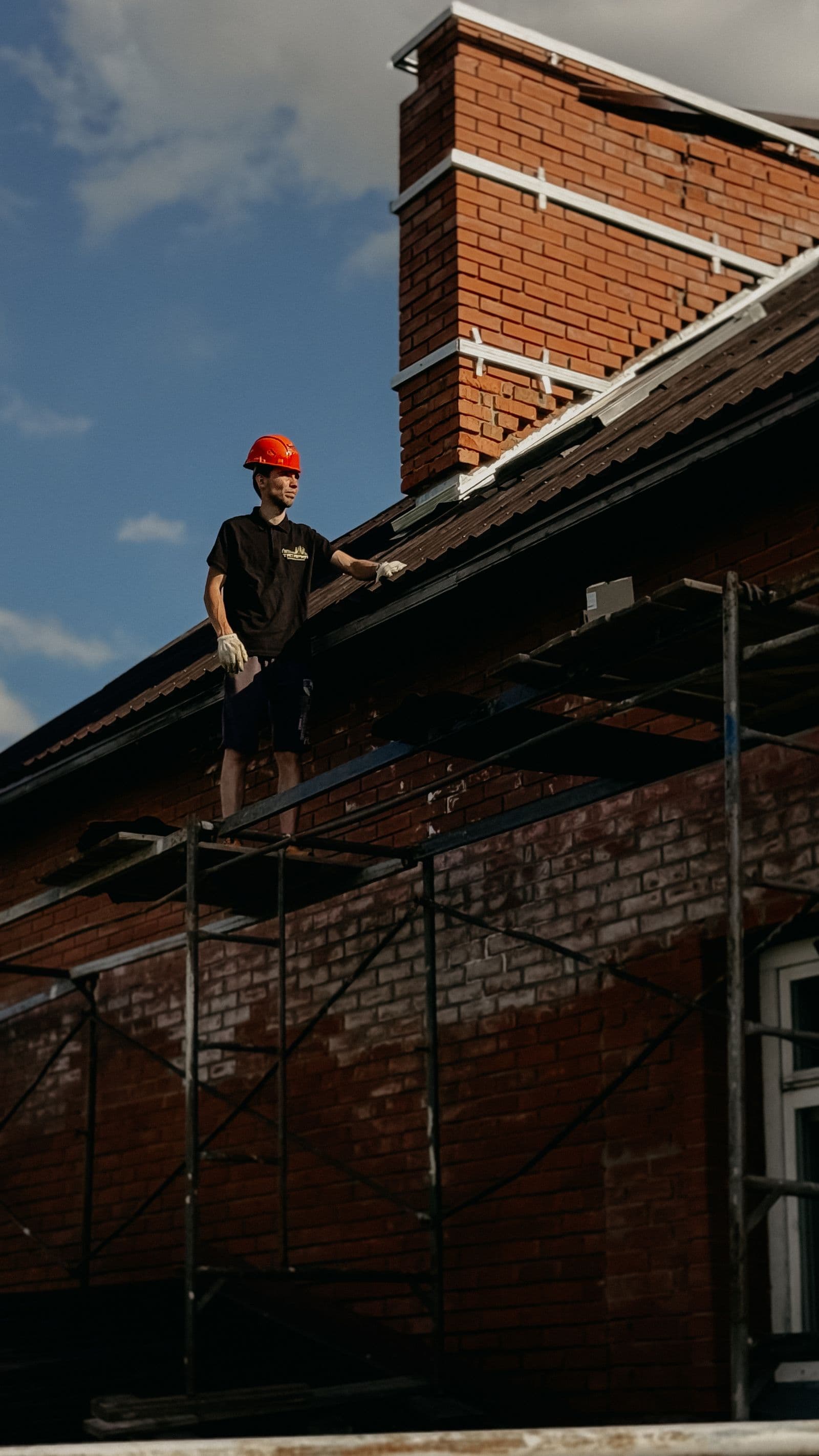
Why the Mortar Has to Stay Softer Than the Brick
Lime mortar is porous and comparatively weak, and both of those are the point. It absorbs the wall's small movements without cracking the units, and it lets water that gets into the masonry leave through the joints instead of through the brick faces. Repoint the same chimney with a hard modern cement mix and the system inverts: the joint is now stronger and less permeable than the brick, so both the movement and the drying are forced into the units instead.
What follows shows up as spalling, the face of the brick flaking or popping off under repeated wetting and drying, usually starting on the weather side and along the joint edges. The joints still look immaculate. They are the reason the brick is coming apart. Standard mortar mixes run from hard to soft, and soft historic brick belongs at the soft, high-lime end of that range, not in the general-purpose middle where most repointing mortar is mixed.
How to Tell Whether This Is Your Chimney
Take a house key to a mortar joint on the least visible face. Lime mortar gives: it scratches, powders, and leaves sand on your fingertip. Cement mortar shrugs the key off and chips rather than crumbles. Then look at the brick. Older units tend to be slightly irregular in size, soft enough to scratch, with a sandy or hand-formed face instead of the sharp wire-cut edges of modern brick. Soft brick, sandy joints, coursing that wanders a little: this page.
Uniform modern brick in gray cement joints, or a chimney built or fully rebuilt in recent decades, is what our brick replacement and repair page is for, and a stack that has lost its structural soundness above the roofline belongs on the chimney rebuild page. Restoration is the option when the original fabric is still worth keeping.
Matching Units, Joints, and the Sand That Colors Them
Replacement brick has to match in three ways, and color is the least important of them. Size comes first, because older brick predates modern dimensional standards, and a unit even a quarter inch off forces the mason to fatten or starve the joints around it until the coursing visibly drifts. Texture is next: a smooth extruded face beside sand-struck neighbors reads as a patch from the sidewalk no matter how close the color got. Units for this work come from salvage stock and from makers who still produce brick in older sizes and finishes. Mortar color follows the same logic.
A joint takes its color mainly from its sand, so matching the aggregate gives you a joint that ages alongside the wall, while pigment stirred into a modern mix gives you one that drifts away from it. Joint profile counts too: whether the original was struck, weathered, or finished flush shaped how water left the face, so copying it is not purely cosmetic.
Repair Before Replacement
Every original brick kept is one nobody has to match. A unit that has spalled on the exposed face but is otherwise sound can often be cut out, turned, and reset with a good face outward. On thin joints and soft brick the cutting out is done with hand tools, because an angle grinder run down a narrow joint takes the arris, the brick's crisp edge, off the units on both sides and widens the joint permanently, damage no amount of repointing puts back. Joints are raked to roughly twice their width and packed in lifts rather than filled in a single pass.
The work also tends to be selective by nature. The crown or mortar wash on top and the few courses above the roofline take the weather first and are usually where the intervention is needed, while the shaft below may want nothing more than attention to a handful of open joints.
Curing and Sealing in Florida
Lime-rich mortar does not set the way cement does. It hardens slowly by taking carbon dioxide from the air, and it has to stay damp while that happens. Full sun on an exposed stack in the region will pull the water out of a fresh joint long before it has cured, leaving mortar that looks finished on the surface and brushes back to powder behind it, so this work gets planned around which face the sun is on, kept shaded and misted, and not hurried. The second Florida rule is what not to do afterward.
A film-forming sealer over soft historic brick traps the moisture the wall keeps taking in from humidity and driven rain, and that trapped water leaves through the face, which is the same spalling arriving by a different road. If anything is applied, it is vapor-permeable, and on plenty of restored chimneys the honest answer is that full joints, a sound crown, and a working cap are the waterproofing.
Free estimate visit
Chimney Repair Service is family-owned and proudly American-owned. A technician can visit the property and give you a free estimate. If you approve paid work, a deposit is required. If you later cancel after paying the deposit, the company keeps the deposit.
Historic Chimney Restoration near you: what local homeowners should know
Reaching out about historic chimney restoration may begin with a visible problem, a maintenance question, or a need for an estimate. A technician can visit and give you a free estimate.
For historic chimney restoration, the visible symptom is a starting point; the proposed repair follows the on-site assessment of the affected component. Weather exposure, moisture, system type, materials, and access vary by property. The technician assesses accessible conditions at your address before a scope is proposed.
What historic chimney restoration costs, and what changes the number
Historic Chimney Restoration does not have one fixed sitewide price. These are the property-specific factors that can change an estimate:
- the observed condition and which component or assembly is affected
- how much of the existing chimney can remain and what access the work requires
- compatibility with the existing masonry, roof, venting, or appliance
- coastal exposure, humidity, storm history, and other property conditions
- any permit, engineering, or third-party requirement confirmed for the job
A technician can look at the chimney or fireplace and give you a free estimate for the requested service.
How the historic chimney restoration estimate process works
Call (754) 328-2421 or use the estimate form. The company confirms the address and current availability. A technician can then visit the property and give you a free estimate.
If you approve paid work, a deposit is required. If you later cancel after paying it, the company retains the deposit.
Historic Chimney Restoration for different home and system types
Coastal salt, inland humidity, heavy rain, and occasional freezes can affect properties differently. The historic chimney restoration proposal should respond to the observed condition, existing construction, and applicable local requirements.
Questions to ask a historic chimney restoration company
When comparing historic chimney restoration companies or contractors, ask what the estimate visit includes, what condition the recommendation addresses, and what happens before paid work is scheduled.
Local historic chimney restoration coverage and availability
Coverage and availability depend on the service address and requested scope. If you are not sure the company covers your address, call (754) 328-2421 and the company will check before confirming an appointment.
The estimate visit is free.
What to confirm before accepting historic chimney restoration
Call (754) 328-2421 or use the estimate form to request availability and a free estimate visit for historic chimney restoration.
- Family-owned and proudly American-owned company.
- Coverage and availability confirmed for the service address.
- Free estimate visit.
- Deposit policy: approved paid work requires a deposit, which is retained if the customer later cancels.