
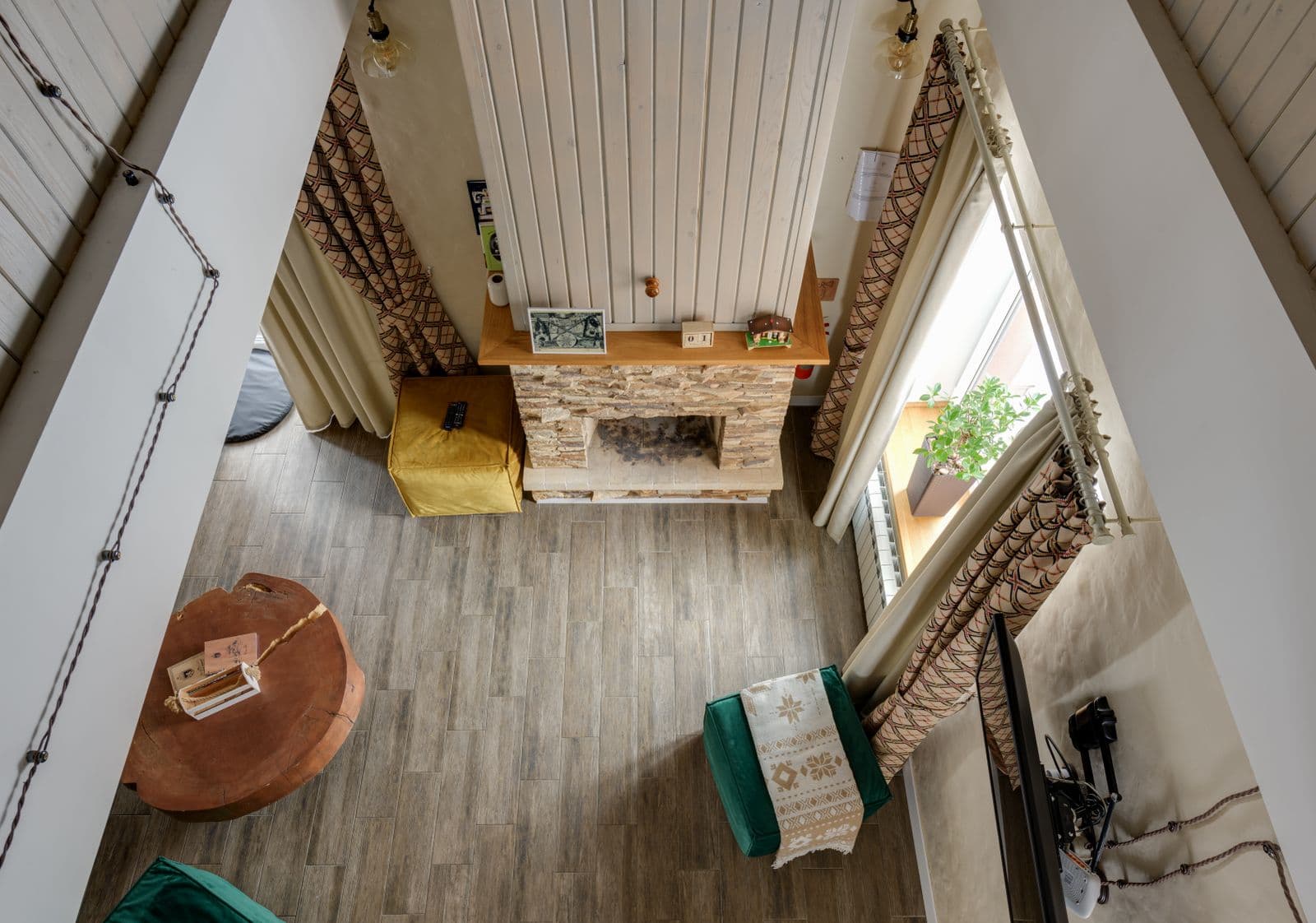
Why Projection Sets the Height
Heat leaves an opening two ways: radiating into the room, and climbing the face above it as a rising sheet of hot air. A shelf standing in that sheet does what any shelf does to moving air. It stops it. The underside of a mantel holds a pocket of heated air against itself for as long as a fire burns, and the deeper the shelf projects, the deeper and hotter that pocket gets. That underside is the hottest wood in the room, which is why a deep beam and a shallow ledge at the same height are different safety questions.
The rule that follows is arithmetic rather than taste. Nothing combustible belongs at the edges of the opening at all, and within the first foot of face above it, projection is rationed against distance at a fixed ratio, about an eighth of an inch for every inch of separation. Run those numbers and they stay small: inside that band the allowance never reaches a couple of inches, while a mantel anybody actually wants projects six or eight. So a real shelf clears the band rather than living inside it.
Factory-built and gas appliances answer to their own label instead, usually a minimum height that climbs with every extra inch of projection. Florida permitting is municipal and requirements vary, so the numbers come from your fireplace and your building department.
What Is Actually Behind Your Fireplace Face
The other half of the job is holding weight, and it opens with a question you cannot answer by looking. A brick face may be solid masonry carried on a footing, a thin veneer set over a wood-framed wall, or the skin of a factory-built chase where the only structure is the framing inside. From the sofa all three look the same, and each holds a mantel differently.
On solid masonry, drilling the unit itself holds more than drilling the mortar joint, but a cracked face brick is permanent and shows while a joint can be raked out and repointed later, and soft old mortar holds less than it looks like it should. Hollow block wants an anchor made for a hollow wall. Veneer holds essentially nothing, so the load has to pass through it into blocking in the framing behind. Blocking added to an open wall is nothing; blocking added behind finished stone is surgery.
Weight, Leverage, and the Support You Never See
A mantel is a cantilever, and that changes the math. Fasteners along the top of a cleat are not carrying the shelf's weight so much as resisting the leverage of that weight held out from the wall, and the further it projects the harder they get pulled. A timber two people can lift can put several times its own weight in tension on the top row. Sizing support to the bare shelf, before anyone hangs anything off the front of it, is how a mantel sags a few years later with a hairline gap along its top edge.
A hollow box beam, built from boards into a shell that reads as solid timber, weighs a fraction of the real thing, hides its cleat, and can be built shallower in projection. Cast stone and steel go the other way: a noncombustible shelf escapes the wood clearance limits and pays for it in weight that wants corbels carrying real load.
Level to the Wall, or Level to the Room
Fireplace faces are rarely flat and almost never plumb. Brick courses wander and veneer varies in thickness stone to stone. A shelf pushed tight to that face and set with a bubble level shows a tapering gap along its back edge, and the eye catches it at once, because it reads a mantel against the ceiling line and the furniture rather than against the masonry. The answer is scribing: the back of the shelf gets cut to the real shape of the wall so it can sit level while the wall is not. Then leave the wood somewhere to go.
Timber moves across its width with moisture, and a Florida house swings between conditioned dry air and open, humid air more than once a year. A reclaimed beam from somewhere drier moves most, so it deserves time in the room before anyone cuts it. Fastened rigidly at both ends across its width, it splits along the grain instead.
Mantel Work, Surround Replacement, or a Full Remodel
Three services overlap here and one test separates them. Stand in front of the fireplace and cover the shelf with your hand. If what is left is a face you are happy with, and the only thing wrong is the shelf itself, missing, loose, undersized, or sitting where it should not, this is your page. If the material around the opening is what bothers you, the tile or brick or stone across the whole face, that is fireplace surround replacement. If the firebox, the hearth, or the appliance is changing as well, that is fireplace remodeling.
The order matters: a mantel decided during a surround project gets its blocking set in an open wall, while one added to a finished face works around whatever is already there.
Free estimate visit
Chimney Repair Service is family-owned and proudly American-owned. A technician can visit the property and give you a free estimate. If you approve paid work, a deposit is required. If you later cancel after paying the deposit, the company keeps the deposit.
Fireplace Mantel Services near you: what local homeowners should know
Reaching out about fireplace mantel services may begin with a visible problem, a maintenance question, or a need for an estimate. A technician can visit and give you a free estimate.
Whatever the job, a technician can visit the property and give you a free estimate for fireplace mantel services. Weather exposure, moisture, system type, materials, and access vary by property. The technician assesses accessible conditions at your address before a scope is proposed.
What fireplace mantel services costs, and what changes the number
Fireplace Mantel Services does not have one fixed sitewide price. These are the property-specific factors that can change an estimate:
- chimney height, roof pitch, and rooftop access on tile or shingle roofs
- the existing materials and weather exposure at the property
- the condition observed during the free estimate visit
- whether the proposed work involves one component or several
- current availability and any applicable permit or third-party requirement
A technician can look at the chimney or fireplace and give you a free estimate for the requested service.
How the fireplace mantel services estimate process works
Call (754) 328-2421 or use the estimate form. The company confirms the address and current availability. A technician can then visit the property and give you a free estimate.
If you approve paid work, a deposit is required. If you later cancel after paying it, the company retains the deposit.
Fireplace Mantel Services for different home and system types
Chimney and fireplace construction varies by property, from older masonry to newer factory-built systems. Fireplace Mantel Services is approached according to the actual chimney, roof access, weather exposure, and approved scope.
Questions to ask a fireplace mantel services company
When comparing fireplace mantel services companies or contractors, ask what the estimate visit includes, what condition the recommendation addresses, and what happens before paid work is scheduled.
Local fireplace mantel services coverage and availability
Coverage and availability depend on the service address and requested scope. If you are not sure the company covers your address, call (754) 328-2421 and the company will check before confirming an appointment.
The estimate visit is free.
What to confirm before accepting fireplace mantel services
Call (754) 328-2421 or use the estimate form to request availability and a free estimate visit for fireplace mantel services.
- Family-owned and proudly American-owned company.
- Coverage and availability confirmed for the service address.
- Free estimate visit.
- Deposit policy: approved paid work requires a deposit, which is retained if the customer later cancels.