
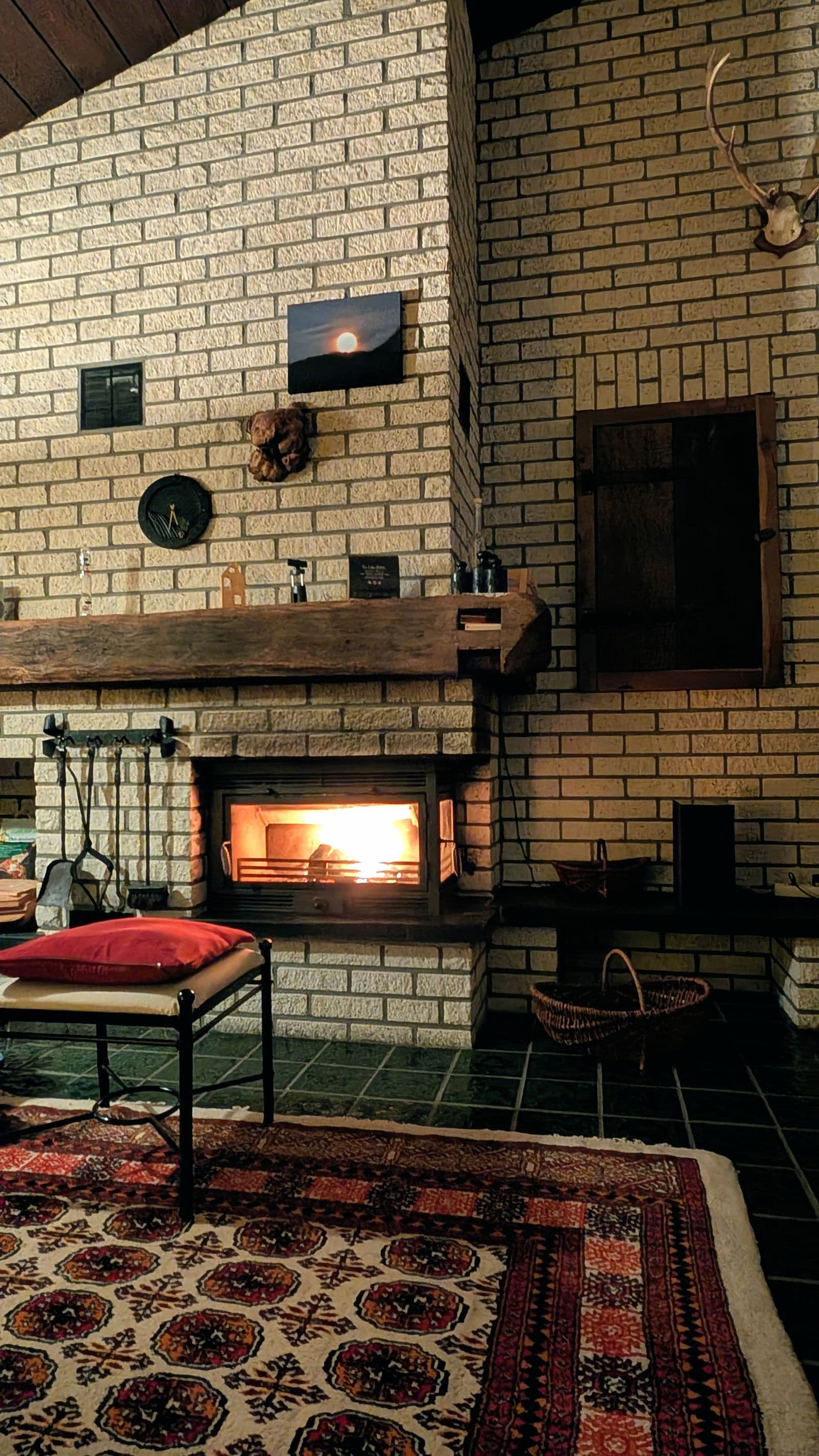
A Ten-Second Test for Which One You Have
Walk up and try to move the front. If a handle, a hinge, or a track lets a panel swing open or slide aside, you own doors, and doors are an accessory: they were added to an opening that worked without them, and they are built to be operated. If the front is one fixed panel held behind a trim frame by clips or latches, and outside on that same wall there is a metal box or a louvered hood, you own a sealed gas unit. A mesh curtain that catches sparks in front of an open fire is a third thing entirely: that is a screen, and separate work.
Nor is the removable mesh barrier on a current sealed gas unit a screen: it ships with the appliance because that pane gets hot enough to burn skin.
Doors on an Open Masonry Fireplace
Doors on an open firebox do two things well and one badly. They put a barrier between the room and a dying fire, and they reduce the volume of conditioned air the firebox trades with the outdoors while nothing is burning. What they do not do is seal. A door set slows air movement; it does not stop it, and it is not a repair for a damper that no longer closes.
Two rules govern the burning side. Wood fires are run with these doors standing open rather than shut, because the pane in a typical door set is not built to face a sustained fire with no air moving across it. And a door set changes the fireplace's proportions: an open masonry fireplace is sized so the flue can carry what the opening feeds it, so putting doors on, or taking them off, changes the air reaching the fire. When a fireplace has smoked since the week the doors went on, or since the week they came off, that timing is the finding.
The Pane on a Sealed Gas Unit Is Not a Door
On a direct-vent gas fireplace the glass closes one face of the combustion chamber, pressed onto a gasket by clips or latches around its frame. The appliance was tested with that panel and that gasket in place, so fitting anything other than the part specified for the model leaves you with a different system than the one that was tested. The gasket squeezed behind it falls under that same specification.
That logic runs through every factory-built fireplace, gas or wood. These units are listed as complete assemblies, and the clearances to the framing around them were established with their own parts fitted. A universal door set off a shelf, hung on a metal firebox that never came with one, is not a cosmetic upgrade. It changes how heat leaves the box, and it puts the unit outside the listing that made its clearances valid.
Tempered or Ceramic: The Wrong One Fails
Tempered glass is ordinary glass heat treated so its outer surfaces hold compression. That is what makes it strong, and what makes it let go into small blunt granules rather than shards. It is what most open-fireplace door sets carry. Ceramic glass is a different material: a glass-ceramic that barely expands as it heats, which is what lets a pane sit inches from a continuous flame without splitting from the temperature difference across its own width. Stoves, inserts, and sealed gas fireplaces use it for that reason.
Put tempered glass where ceramic was specified and it will not survive. Ordinary window glass belongs in neither, whatever a glass shop is willing to cut. Ceramic panes in gas units also tend to carry a coating, which is why an ammonia-based window spray is the wrong bottle: ammonia attacks that coating, and once it has clouded no cleaner brings it back, so the pane becomes a parts order rather than a cleaning. A chipped edge causes more replacements than any of that.
Because tempered glass carries its strength at the surface, a nick on the edge is not a blemish, it is a starting point for the next crack, and a pane damaged during an earlier install is a replacement rather than something to watch.
Measuring, Mounting, and What Fails First Here
Masonry openings are rarely true rectangles, so correct sizing may require checking width and height at several points and accounting for the tightest reading. The mounting face matters too: rough brick, a proud lintel, or a raised hearth can prevent continuous contact. Any measurement, custom fabrication, frame preparation, or installation deliverable must be stated in the service details.
In Florida the glass usually outlives the hardware around it. Hinges, latch cams, and mesh curtain pulls corrode in the humid air that settles into a firebox, faster on the Atlantic side and along the Gulf coast. Once a latch no longer draws the panes up against their stops, the doors have stopped working even though the glass looks perfect. That is the real replace-or-refit conversation, and it starts with a free estimate visit: (754) 328-2421.
Free estimate visit
Chimney Repair Service is family-owned and proudly American-owned. A technician can visit the property and give you a free estimate. If you approve paid work, a deposit is required. If you later cancel after paying the deposit, the company keeps the deposit.
Fireplace Glass Installation and Replacement near you: what local homeowners should know
Reaching out about fireplace glass installation and replacement may begin with a visible problem, a maintenance question, or a need for an estimate. A technician can visit and give you a free estimate.
Whatever the job, a technician can visit the property and give you a free estimate for fireplace glass installation and replacement. Weather exposure, moisture, system type, materials, and access vary by property. The technician assesses accessible conditions at your address before a scope is proposed.
What fireplace glass installation and replacement costs, and what changes the number
Fireplace Glass Installation and Replacement does not have one fixed sitewide price. These are the property-specific factors that can change an estimate:
- chimney height, roof pitch, and rooftop access on tile or shingle roofs
- the existing materials and weather exposure at the property
- the condition observed during the free estimate visit
- whether the proposed work involves one component or several
- current availability and any applicable permit or third-party requirement
A technician can look at the chimney or fireplace and give you a free estimate for the requested service.
How the fireplace glass installation and replacement estimate process works
Call (754) 328-2421 or use the estimate form. The company confirms the address and current availability. A technician can then visit the property and give you a free estimate.
If you approve paid work, a deposit is required. If you later cancel after paying it, the company retains the deposit.
Fireplace Glass Installation and Replacement for different home and system types
Chimney and fireplace construction varies by property, from older masonry to newer factory-built systems. Fireplace Glass Installation and Replacement is approached according to the actual chimney, roof access, weather exposure, and approved scope.
Questions to ask a fireplace glass installation and replacement company
When comparing fireplace glass installation and replacement companies or contractors, ask what the estimate visit includes, what condition the recommendation addresses, and what happens before paid work is scheduled.
Local fireplace glass installation and replacement coverage and availability
Coverage and availability depend on the service address and requested scope. If you are not sure the company covers your address, call (754) 328-2421 and the company will check before confirming an appointment.
The estimate visit is free.
What to confirm before accepting fireplace glass installation and replacement
Call (754) 328-2421 or use the estimate form to request availability and a free estimate visit for fireplace glass installation and replacement.
- Family-owned and proudly American-owned company.
- Coverage and availability confirmed for the service address.
- Free estimate visit.
- Deposit policy: approved paid work requires a deposit, which is retained if the customer later cancels.