
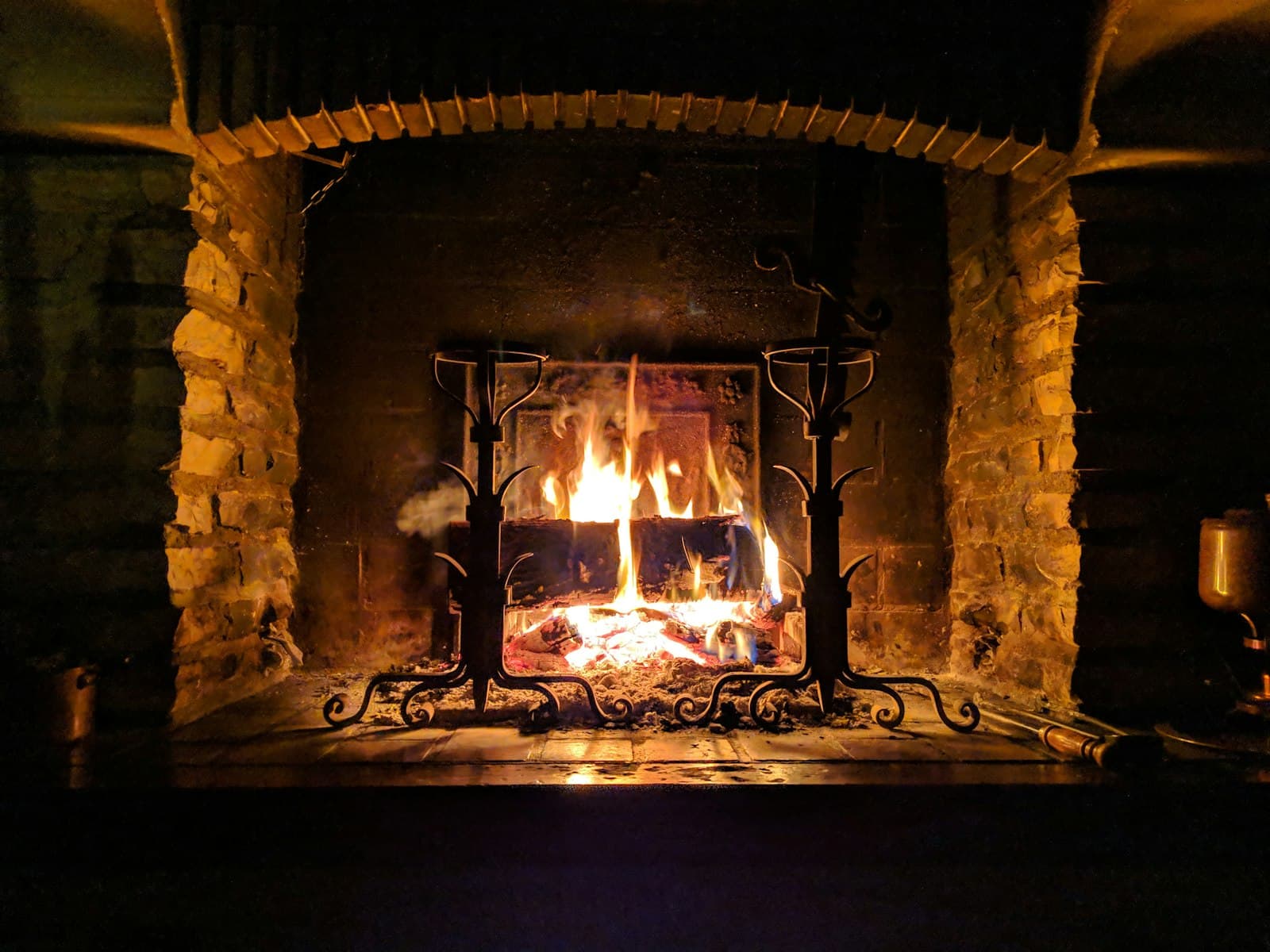

The short answer: geography decides
A wood stove is a heating appliance, so the worth-it question starts with expected use. North Florida and the Panhandle have a short but genuine heating season. In Central Florida, homeowners should weigh a smaller number of cool-weather uses against installation, fuel storage, maintenance, and venting requirements.
The distinction matters because a stove asks more of you than a fireplace does. It wants fuel bought, stored, and kept dry in a climate that fights you on all three. It takes up floor space, dictates furniture placement, and needs a properly matched chimney. Those are reasonable costs where winter actually shows up, and dead weight where it doesn’t. The honest framing for the rest of this guide is simple: buy the tool where the job exists.
Why a stove out-heats an open fireplace
Start with what an open fireplace actually does on a cold night. A fire needs air, and an open firebox pulls it in enormous volume: straight out of the room, past the flames, and up the flue. Along with that air goes most of the fire’s heat. What you feel is the radiant warmth directly in front of the opening, while the draft quietly exhausts the warm air everywhere else in the house. When the fire dies down and the damper has to stay open until the ashes are cold, the flue keeps pulling heated air out of the room all night. An open fireplace is wonderful theater; as a heater, it works against itself.
A stove closes that loop. The fire burns inside a sealed steel or cast-iron box, and you control how much air reaches it, so the wood burns slower, hotter, and more completely. The metal body becomes a radiator that soaks the room in heat for hours, and modern stoves route the smoke through a second combustion pass that pulls even more heat out of the same log, with less unburned residue heading up the flue as creosote. The practical difference is not subtle: most of an open fireplace’s heat leaves through the chimney, while most of a stove’s heat stays in the house. One decorates a room; the other heats it.
Florida’s heating season, honestly mapped
In Pensacola, Tallahassee, Lake City, and the rural stretches of North Florida, winter reliably arrives. It is short (weeks of stove-worthy nights rather than months), but it is real: strings of nights in the 30s and 40s, freeze warnings, and in the Panhandle the occasional hard freeze that has the whole neighborhood’s heat pumps straining. Those are the nights a stove transforms. Central Florida gets a handful of evenings like that per winter; Tampa and Orlando homeowners can usually count them on two hands. South of the lake, a stove would sit cold essentially year-round.
There is a resilience angle that lands differently up north, too. The same cold snaps that make a stove useful sometimes arrive with ice-stressed power lines, and a wood stove heats with no electricity at all. Its flat top will keep a kettle or a pot of soup going through an outage. Hurricane-season outages are the hot-weather version of the same story: no heat needed, but a cooking surface that works when the grid doesn’t. And in North Florida, oak firewood is plentiful and easy to come by, sometimes just for the hauling. The catch is seasoning it: green wood needs many months split, stacked off the ground, top-covered with the sides left open to breathe, because Florida humidity is slow to give moisture back.
What a proper installation involves
A stove is not furniture you set down and light. The floor under and around it needs listed non-combustible protection (a hearth pad extending beyond the loading door), because embers and radiant heat will find bare flooring otherwise. Walls are governed by the clearances printed on the stove’s own label: every model is tested to specific distances from combustible surfaces, reduced only by shielding the listing allows. In a typical Florida family room, those clearances decide where the stove can live far more than aesthetics do.
The chimney is the bigger question. A stove cannot simply exhaust into a big open fireplace flue, because a flue that is too large for the stove’s collar lets the smoke slow down and cool. And cool, slow smoke condenses onto the flue walls as creosote, which is flammable. The right setup matches the flue to the stove: in an existing masonry chimney that means a stainless steel liner sized to the stove’s outlet, insulated where the listing calls for it, running the full height of the chimney. In a house with no chimney at all, a freestanding stove uses a listed insulated metal chimney run through the roof. Either way, the flue is half the appliance.
One Florida-specific caution before you fall in love with an insert: a large share of Florida homes built since the 1980s have factory-built fireplaces inside a wood-framed, stucco-clad chase that only looks like masonry from the street. Those are tested systems, and you cannot put a wood stove or an arbitrary insert into one unless that exact combination is listed. For many units, nothing is. A pro can tell you within minutes which kind of fireplace you own. Permits and inspection requirements for solid-fuel appliances vary by municipality across Florida, so verify locally before any work starts.
Tell your insurance carrier: before, not after
A wood-burning stove is exactly the kind of thing homeowners insurance carriers want to know about, and many application and renewal forms ask about solid-fuel appliances directly. What happens next varies widely: some carriers simply note it, some ask for details about how and by whom it was installed, some adjust the premium, and some attach conditions. There is no single Florida-wide rule here (requirements differ by carrier and by policy), so the right move is a call to your agent before you buy the stove, not after it is burning.
The reason to be disciplined about this is the failure mode. If a stove is ever involved in a claim and the carrier learns it was never disclosed, you have handed them an argument at the worst possible moment. A disclosed stove with a documented, properly done installation is a routine conversation instead. Keep a simple file: the stove’s manual and listing label information, the installation paperwork, and permit records where your municipality requires them. Ten minutes of filing now is cheap protection later.
When a stove is the wrong buy
If what you actually want is atmosphere (a fire to look at on the handful of cold evenings your area gets), a stove is the wrong tool. The open fireplace already in your house does ambiance better: bigger flames, open hearth, the crackle unmuffled by a glass door. A stove pointed at a Boca Raton or Fort Myers winter is a heater without a job, and the few times you light it you may find yourself opening windows while the air conditioner argues with it. South of roughly the I-4 corridor, the heat a stove makes is mostly heat your AC then has to remove.
A stove is also the wrong buy when the logistics don’t fit your life. It needs a steady supply of dry, seasoned wood and somewhere to store it (a genuine project in a humid climate), plus regular ash handling and a chimney swept on schedule, because a stove burned all winter makes creosote faster than an occasionally lit open fireplace. It permanently claims floor space and becomes the visual center of the room whether or not it is burning. And if your existing fireplace turns out to be a factory-built unit in a framed chase, the install you were imagining may not be possible in the form you pictured. None of these are reasons to fear stoves; they are reasons to be honest about whether yours would ever really burn.
What drives the price, and the smart first step
Shopping the appliance alone is the classic mistake, because the stove is usually the smaller part of the story. What completes the job is the stainless liner sized to the stove’s outlet, the hearth protection, the clearance work, and the labor to do all of it, and that side of the ledger is set by your house, not by the model you liked in the showroom. A sound masonry chimney that needs nothing but a liner is the straightforward version. A chimney that needs repair or relining first is a bigger job, and a house with no chimney at all, where a full insulated metal chimney has to be built and run through the roof, is bigger still. The only figure that counts for your house is a free estimate stating the proposed price, produced after someone has actually looked at your chimney.
That points to the smart first step: have a qualified chimney professional inspect what you already have. Whether the chimney is real masonry or a factory-built system, what condition the flue is in, and what a liner path would look like are the three facts that turn this from daydream into decision. With those in hand, the worth-it question answers itself: a real scope of work on one side, your county’s actual winter on the other. In Pensacola that math often works. In Palm Beach it almost never does, and an honest pro will tell you so.