

Start with how you'll actually use it
In Florida an outdoor fire feature is not a heat source you tolerate for warmth; it is a gathering point you build a patio around. It earns its keep on cool evenings from late fall through early spring, and the rest of the year it works as a focal point, a place to sit after dark, and a reason to be outside once the afternoon heat breaks. Because warmth is rarely the point, your decision hinges on ambiance, siting, upkeep, and what survives our climate, not BTUs. Two forks decide everything else: the fuel and the structure.
The first fork is fuel: wood or gas. The second is structure: a permanent masonry fireplace or fire pit built into the patio, versus a prefabricated kit or a portable unit you can move or take with you. Those two choices interact: a portable wood bowl and a plumbed gas masonry fireplace sit at opposite ends of cost, commitment, and permitting. Everything in this guide comes back to placing your yard, your budget, and your tolerance for maintenance somewhere along those two axes. Start there, and the product decisions get much simpler.
One Florida reality shapes the whole conversation early: the screen enclosure. Pool cages and screened lanais cover a large share of the state's usable outdoor space, and open flame and aluminum screen do not mix. Embers melt or ignite screening, and combustion needs open air. Where you can legally and safely put a fire feature is often decided by whether the spot is screened, covered, or open to the sky, so settle that before you fall in love with a specific unit. We come back to clearances below, but let it steer your first sketch of the yard.
Wood vs. gas: the fuel decision
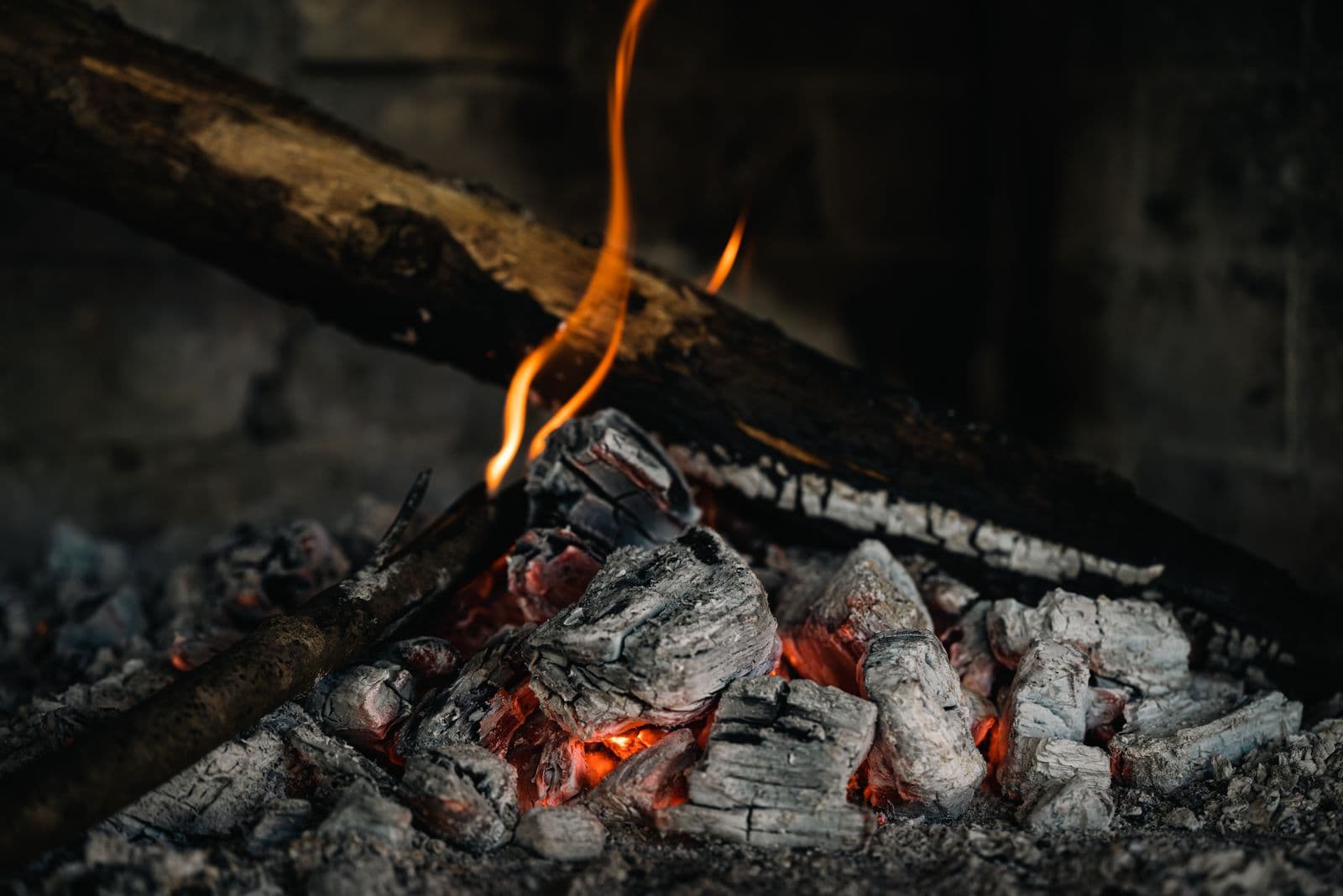
Wood delivers the real thing: live flame, crackle, the smell of a fire, and radiant heat that feels like heat. The unit itself is usually the cheapest way into a fire feature, and there is nothing to plumb. The costs are the ones you pay every night: sourcing and storing dry firewood, tending the fire, and cleaning ash afterward. Florida adds its own tax here, because our humidity keeps wood damp and slow to season, and green or wet wood smokes heavily, an issue for you, your guests, and neighbors on a tight suburban lot.
Gas (natural gas if your street has service, propane if it does not) trades authenticity for convenience. There is no smoke, no ash, no sparks, and no sourcing wood; you turn a knob and the fire is on, then off. That control is why gas dominates newer outdoor kitchens and why it plays better under partial cover and near screen enclosures, where wood smoke and embers are a problem. The trade-offs are a real installation, a plumbed line or a propane tank, and a flame that, however handsome, reads as a controlled burner rather than a campfire.
For most Florida backyards the honest lean is toward gas: the climate, the neighbors, the screen cages, and the year-round-ambiance use pattern all favor a clean, instant, smokeless flame. Wood still wins for the purist who wants a genuine campfire, has open sky and room to place it well, and does not mind the work. Plenty of homeowners split the difference: a gas fireplace or built-in burner near the house for everyday use, and a simple portable wood pit set well out in the open yard for the nights that call for real flame.
Permanent masonry vs. prefab and portable
A permanent masonry fireplace or fire pit is built on a footing from block, brick, or stone, often the same stucco-over-concrete-block (CBS) construction as Florida houses, then faced with stone or tile. It is the most durable and best-looking option, it becomes part of the home and the listing, and it is the most expensive and least reversible. It also carries the most red tape: a poured footing, a permanent gas line, and a tall chimney are exactly the elements that trigger permits and HOA architectural review, so a masonry build is a planned project, not a weekend purchase.
Prefabricated kits sit in the middle. These are modular block or steel-and-panel systems (a fire-pit ring or a fireplace shell) that a crew assembles on a prepared pad and finishes with veneer, reaching a masonry look for less time and money than full custom stonework. They still want a level, drained base and, for gas, a proper line, and larger built-in kits still commonly need a permit. Done well, a finished kit is hard to distinguish from custom masonry; built on a poor base, it settles, cracks, and telegraphs every shortcut within a few Florida rainy seasons.
Portable units (steel or aluminum bowls, cast-concrete tables, and propane pits that run off a hidden twenty-pound tank) are the fastest, cheapest, and most flexible path. They need no permit and no construction, they move for a party or a hurricane, and they leave with you when you sell. The compromises are lifespan and presence: lighter metals corrode faster outdoors, especially near the coast, and a movable bowl never anchors a patio the way built-in stone does. For renters, tight budgets, and anyone unsure of their final layout, portable is a sensible first step.
Fire pit or outdoor fireplace?
The two forms suit different yards and different nights. A fire pit is low and open on all sides, so people gather around it in a circle. It is the social, casual option, and it fits an open patio or a spot out in the yard. Because it is open, it is also the more wind-exposed of the two: a gusty evening blows smoke and heat sideways and scatters embers, which matters more with wood than gas. A pit reads as relaxed and communal, and it is usually the cheaper structure to build or buy.
An outdoor fireplace is tall, vertical, and directional. It throws its heat and light one way, doubles as a wind block and a privacy screen, and gives a patio a strong architectural anchor. It is the more formal, more dramatic option and, with its chimney and larger footprint, the more expensive one. That vertical chimney also helps carry smoke up and away from seating, a real advantage for a wood fireplace on a smaller lot. The trade is footprint and cost: a fireplace commands a wall or a corner and a bigger budget than a pit.
In Florida terms, a fire pit tends to suit the open half of a pool deck or a back-corner lounge under open sky, while a fireplace often anchors the edge of an open-air patio or an outdoor kitchen. Neither belongs under a screen cage or a low wood-framed roof with an open flame, and a tall wood-burning fireplace in particular needs clear sky above its chimney. Match the form to the spot you actually have open to the air, not to a photo of a yard with far more clearance than yours.
Safety and clearances you don't get to skip
Every fire feature needs clearance from anything that can burn. Keep flame well away from the house wall, the eaves and soffits, wood fencing, low-hanging trees, and patio furniture, and follow the clearances the manufacturer prints for that specific unit; those numbers are the baseline, not a suggestion. Overhead matters as much as sideways: an open flame wants open sky, not a soffit, a pergola with a solid roof, or the aluminum-and-screen of a pool cage, where rising heat and stray embers damage the enclosure and rob the fire of the air it needs to burn cleanly.
Gas adds its own rules. Propane is heavier than air, so it pools in low spots instead of dissipating, which is why a leak around a pit or an enclosed tank cabinet is dangerous, and why gas fire features should never run in a poorly ventilated or sunken space. Store propane tanks upright and outdoors, away from the flame, and shut them off after use. For any built-in gas fireplace with a chimney or vent, the national reference is NFPA 211, the standard covering chimneys, fireplaces, and venting; building to that standard is what a competent pro works to and what a plan reviewer expects to see.
Keep a few simple habits in place: a spark screen on a wood pit, a hose or extinguisher within reach, no fire left unattended, and no lighter fluid or gasoline used to start or feed flames. Never light a fire in high wind or during a red-flag dry spell; Florida's dry season and brush can turn a stray ember into a real problem. If you smell gas and cannot immediately place and stop it, shut the supply, leave the area, and call for help; do not go hunting for a gas leak with an open flame anywhere nearby.
HOA, permits, and property lines: the general reality
Treat this as a planning step, because rules genuinely vary by city, county, and community, and this guide cannot substitute for your local building department. The general pattern across Florida holds up, though: a portable, freestanding unit is the least regulated, while anything permanent (a poured footing, a masonry structure, a run of gas line, a tall chimney) is the most likely to require a permit and inspection. Gas work in particular is where permitting shows up, because a plan reviewer wants to see the line sized, routed, and pressure-tested correctly.
Homeowners' associations are a separate gate from the county, and in much of Florida the HOA is the stricter of the two. Many associations run architectural review on anything built in the yard, restrict height and placement, and have their own take on propane tanks, chimneys, and where a structure can sit relative to the property line and setbacks. Get their approval in writing before you build, not after. Neighbors and party walls matter too: on a tight lot, a smoky wood fire drifting next door is both a nuisance complaint waiting to happen and, sometimes, a code issue.
The practical move is to confirm three things before you spend: what your municipality requires for the specific structure and fuel you want, what your HOA's architectural rules allow, and where your setbacks and any utility easements fall. A local pro who builds these features routinely will know which of your plans need a permit and can build to code and pull it, and a good one will not talk you into skipping that step. Getting this right up front is far cheaper than being told to tear out a finished, unpermitted fireplace later.
Salt air and coastal material choices
On the coast, materials are the whole game, because salt-laden air corrodes metal fast and punishes anything porous. The single most important spec on a coastal gas unit is the stainless steel grade: 304 stainless is fine inland, but near the ocean you want 316 (marine grade), whose added molybdenum resists salt-driven pitting far better. Plain or galvanized steel is a poor choice within sight of the water (it will streak with rust in a season or two), and aluminum, while rust-proof, can still pit, so look for quality powder-coated or marine-rated finishes.
Masonry has coastal weak points too. Salt works its way into porous brick, block, and mortar, then crystallizes and flakes the surface: the same spalling and efflorescence Florida chimneys are known for. Sealing the masonry with a breathable water repellent slows salt and moisture intrusion while still letting the wall dry, and it is worth redoing periodically on the coast. Choose dense, well-fired brick or natural stone over soft, absorbent units, specify a quality mortar, and keep horizontal surfaces sloped to shed water rather than pond it. Standing water is what drives salt and moisture into the structure.
The rest is hardware and habits. Burners, ignition parts, screens, fasteners, and tank fittings should all be corrosion-resistant, because on the coast the cheap components fail first and take the fun with them. A fitted, breathable cover between uses keeps salt spray and rain off the metal, and a periodic freshwater rinse of exposed stainless and hardware genuinely extends its life. None of this is exotic; it is simply the difference between a fire feature that looks tired in two coastal summers and one that still looks right in ten.
Smoke, wind siting, and upkeep in the humidity
Siting is where a fire feature succeeds or fails, and in Florida the wind you plan around is the sea breeze, generally onshore during the day and often shifting in the evening. Watch how air actually moves across your yard on the evenings you would use the fire, then place seating upwind and the fire downwind so smoke and heat drift away from people, the house, and any screen enclosure. Give a wood fireplace's chimney clear sky, keep a pit out of the wind shadow of walls that cause swirling, and leave generous open space around the whole thing.
Maintenance in our climate is mostly about water and rust. An open fire pit fills with rain, so it needs drainage or a cover, and standing water plus ash makes a corrosive sludge that eats a steel bowl from the inside. Empty and dry it, and cover it between uses. Gas features hide a Florida-specific nuisance: spiders and wasps love to nest in warm burner tubes and orifices during the long idle months, and a blocked port makes for a weak, yellow, or uneven flame. Clearing insect nests, checking connections, and testing ignition before the first cool front is exactly the seasonal once-over these units want.
For a built-in gas fireplace with a chimney, or a permanent masonry structure, an annual look from a qualified professional who works on outdoor fire features is worth considering. The service scope should be confirmed for the specific unit and may include burner, gas-connection, venting, masonry, and chimney concerns. Chimney Repair Service is family-owned and proudly American-owned. A technician can visit the property and give a free estimate. Questions can be directed to (754) 328-2421.