
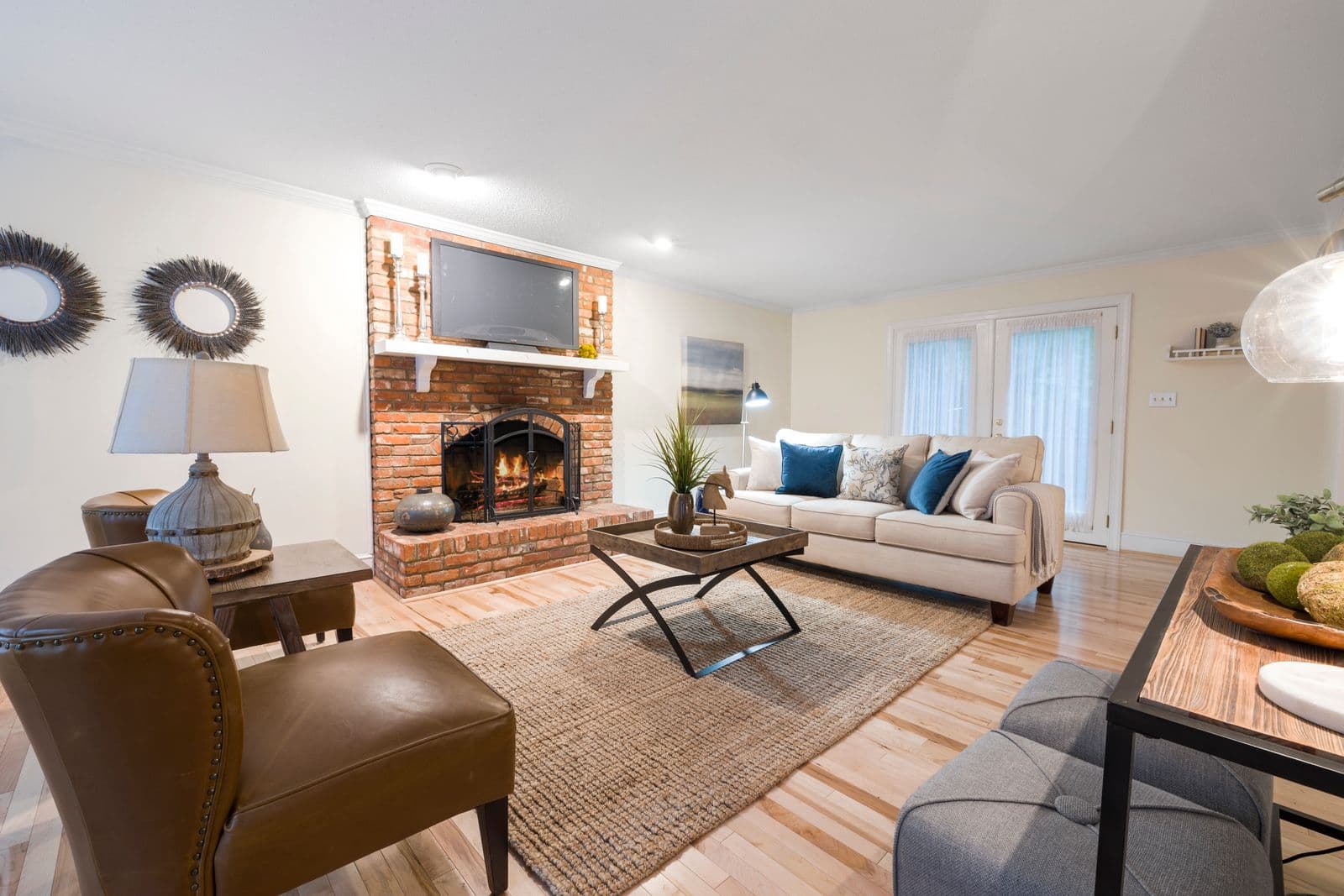

The first question about any fireplace: where does the exhaust go?
Every fireplace, gas or wood, has to answer one question: what happens to the byproducts of the fire? Combustion produces hot gases, water vapor, and, depending on the fuel and the burner, carbon monoxide and soot. The venting system is the machinery that answers that question, and it is the single most important thing to know about the fireplace you own: it determines how the appliance behaves, what can go wrong, and what a repair visit actually involves.
In Florida homes with gas fireplaces, three venting designs cover nearly everything you will encounter: natural vent (usually called B-vent), direct vent, and vent-free. Wood-burning fireplaces (whether a traditional masonry chimney or a factory-built metal unit) form their own category with their own logic. This guide walks through how each one works in plain language, how to figure out which one is in your living room, and why the answer changes everything about service and repair.
Natural vent (B-vent): the traditional approach, translated to gas
A B-vent fireplace works on the same principle as an old-fashioned open fireplace: hot air rises. The firebox is open to the room (often behind a mesh screen or operable glass doors), and it draws the air it burns from inside the house. The exhaust rises by its own buoyancy up a single round metal pipe, typically double-wall, with an inner pipe carrying the hot gases. That pipe must run vertically, or nearly so, and terminate above the roof with a cap, because the whole system depends on gravity-driven draft rather than any fan or seal.
The strength of B-vent is simplicity: fewer parts, an open flame, a familiar fireplace experience. The trade-offs follow from the same openness. Because it exhales warm house air up the flue, it is the least efficient of the three designs, and because it relies on natural draft, it inherits all the draft sensitivities of a traditional chimney: a competing exhaust fan, a tightly sealed house, or a poorly placed termination can make it spill or burn lazily. If your gas fireplace occasionally smells faintly when it starts, or behaves differently when the air conditioning and bath fans are running, natural draft is usually the reason.
Direct vent: sealed glass and a two-pipe system
A direct-vent fireplace takes the opposite approach: it seals the fire away from the room entirely. The front is a fixed pane of glass, gasketed in place, and the firebox breathes only through its venting: one passage brings combustion air in from outside, another carries exhaust out. Most systems do this coaxially, a pipe within a pipe: exhaust flows through the inner pipe while fresh air travels in through the surrounding outer pipe, warming on the way. Because the appliance never touches room air, the vent does not need to rise to the roof by buoyancy alone; many direct-vent fireplaces vent horizontally straight through an exterior wall.
This sealed-combustion design is why direct vent has become the default for new gas fireplaces. It keeps conditioned indoor air indoors (no small thing where the air conditioning runs most of the year), it is largely indifferent to house pressure and competing fans, and it puts a physical barrier between the flame and the living room. The glass is not decorative; it is part of the combustion system. If the glass is cracked, or the gasket around it has flattened or frayed, the appliance is no longer the sealed system it was designed to be, and that is a genuine reason to stop using it until a pro has looked at it.
The trade-off is that a direct-vent fireplace is more appliance than hearth: the flame lives behind glass, and every part (gaskets, vent pipe, termination) is specified by the manufacturer. That specificity is a feature for safety and a constraint for repair, which we will come back to.
Vent-free: no flue at all, and why that deserves real thought
A vent-free (or ventless) fireplace has no chimney, no pipe, no termination: nothing penetrates the wall or roof. It is engineered to burn its gas so completely that the byproducts, mainly water vapor and carbon dioxide, are released directly into the room at levels the design treats as acceptable. To make that work, the burner is built to tight tolerances and the unit carries an oxygen depletion sensor, a pilot-based safety device that shuts the gas off if the oxygen level in the room drops below its threshold.
Vent-free deserves a calm, honest treatment, because opinions on it run strong in both directions. The engineering is real: these are precision appliances, inexpensive to install and immune to draft problems by definition. But everything the fire produces stays in the house, including a meaningful amount of water vapor, worth pausing on in a state where the air conditioner already spends its life fighting humidity. Room size, run time, and household circumstances all matter; the rules on where vent-free appliances may be installed vary from place to place; and their suitability is genuinely situational rather than universal. None of this is cause for alarm if you own one. It is a reason to size the unit correctly, keep the burner and sensor clean and unmodified, and treat long continuous burns differently than you would with a vented fireplace.
The practical takeaway: with no venting system to inspect, the maintenance conversation on a vent-free fireplace is entirely about the appliance itself: the burner, the logs, and the oxygen depletion sensor carry all of the weight.
How to tell which one you own in five minutes
Start at the front of the fireplace. A fixed glass panel that does not open is the signature of direct vent. An open firebox (or one with a mesh curtain or glass doors you can operate) burning gas logs is either a B-vent appliance or a set of vented gas logs installed inside a traditional masonry fireplace. And a gas fireplace set into a wall with no chimney above it and no vent cap anywhere outside, often with a label mentioning an oxygen depletion sensor or "unvented" operation, is vent-free.
Then step outside. A round metal cap at the roofline above the fireplace points to B-vent or a factory-built wood unit; a square or louvered termination on an exterior wall, roughly behind the fireplace, is the giveaway of a horizontally run direct vent; nothing at all, anywhere, confirms vent-free. If the house has a full masonry chimney (brick or stucco, with a crown and flue at the top), you are dealing either with a wood-burning fireplace or with gas logs living inside one, which keeps the masonry chimney and all of its maintenance needs fully in play.
The authoritative answer is the rating plate: a small metal tag, usually tucked just inside the bottom louvers or under the firebox floor, listing the manufacturer, model, and vent type. Photograph it: in gas fireplace work, the model number is the difference between a productive first visit and a second trip for parts.
What service looks like for each type
For B-vent and for gas logs in a masonry chimney, service looks the most like traditional chimney work: the flue, cap, and draft are the story. Gas exhaust is rich in water vapor, and that moisture is mildly corrosive to metal vents and hard on masonry interiors, so the recurring issues are corroded pipe sections, rusted caps, staining, and blockages: in Florida, often a nest, since a rarely used flue is prime real estate for the state's wildlife. Draft complaints round out the list, and they are diagnosed the same way as on a wood-burning chimney.
Direct-vent service is appliance work. The recurring items are the glass gasket, the condition of the logs and burner, the pilot or ignition system, the blower if fitted, and the termination outside, which must stay clear of vegetation and storm debris. On coastal homes, salt air corrodes exterior terminations and their fasteners faster, and a rusted-through termination defeats the sealed system it serves. Vent-free service, as noted, concentrates entirely on the burner assembly, the logs sitting exactly where the manual places them, and a clean, functioning oxygen depletion sensor: dust and pet hair are its usual enemies.
Wood-burning fireplaces keep their own familiar regimen (sweeping, inspection, and the masonry or liner repairs Florida weather makes necessary), and NFPA 211 calls for an annual inspection regardless of how much the fireplace was used. That annual rhythm is worth keeping for gas fireplaces too, precisely because their problems are quiet ones: a flattened gasket or a corroded vent does not announce itself the way a smoking fireplace does.
Why venting type drives what repairs look like
Here is the mechanism worth understanding: the venting design defines which parts exist, and parts are what fail. A B-vent system can fail at its pipe joints, cap, and draft; a direct-vent system can fail at its gasket, glass, and termination; a vent-free unit can only fail at its burner and sensor. When a homeowner calls about "the fireplace not working," the venting type is what turns that sentence into a short list of likely causes, which is why it is the first question a good pro asks.
Venting type also draws hard boundaries around what repairs are possible. Gas fireplace components are engineered as matched systems, tested with specific vent pipe, terminations, and glass, and substituting across brands or types is not a judgment call a pro can make for you. The practical consequence is that "converting" between venting types is not a modification but a replacement, because the venting is designed into the appliance rather than bolted onto it. Understanding that up front points the conversation toward the real decision: repair the system you have, or replace it with the type you actually want.
Florida wrinkles, and when to bring in a pro
Florida adds a few twists worth naming. Fireplaces here sit unused for most of the year, and idle systems develop problems quietly: humidity works on metal vents and gaskets through the long summer, insects and animals move into terminations and flues, and the first cool evening of December is when everything gets discovered at once. A brief check ahead of the season (glass and gasket intact on a direct vent, cap and flue clear on a B-vent or masonry flue, burner clean on a vent-free unit) is the cheapest habit a Florida fireplace owner can keep.
When something does need attention, the cost conversation follows the venting type too. As a market observation rather than a quote: simple service items like a gasket, cap, or termination repair tend to sit at the modest end, while vent replacement or appliance-level repairs climb from there, moving with access and parts. The real number for your fireplace comes from a free estimate after a qualified chimney professional has actually seen the unit and its rating plate. If you are not sure what you own, that same visit answers the question, and shortens every future service call.