
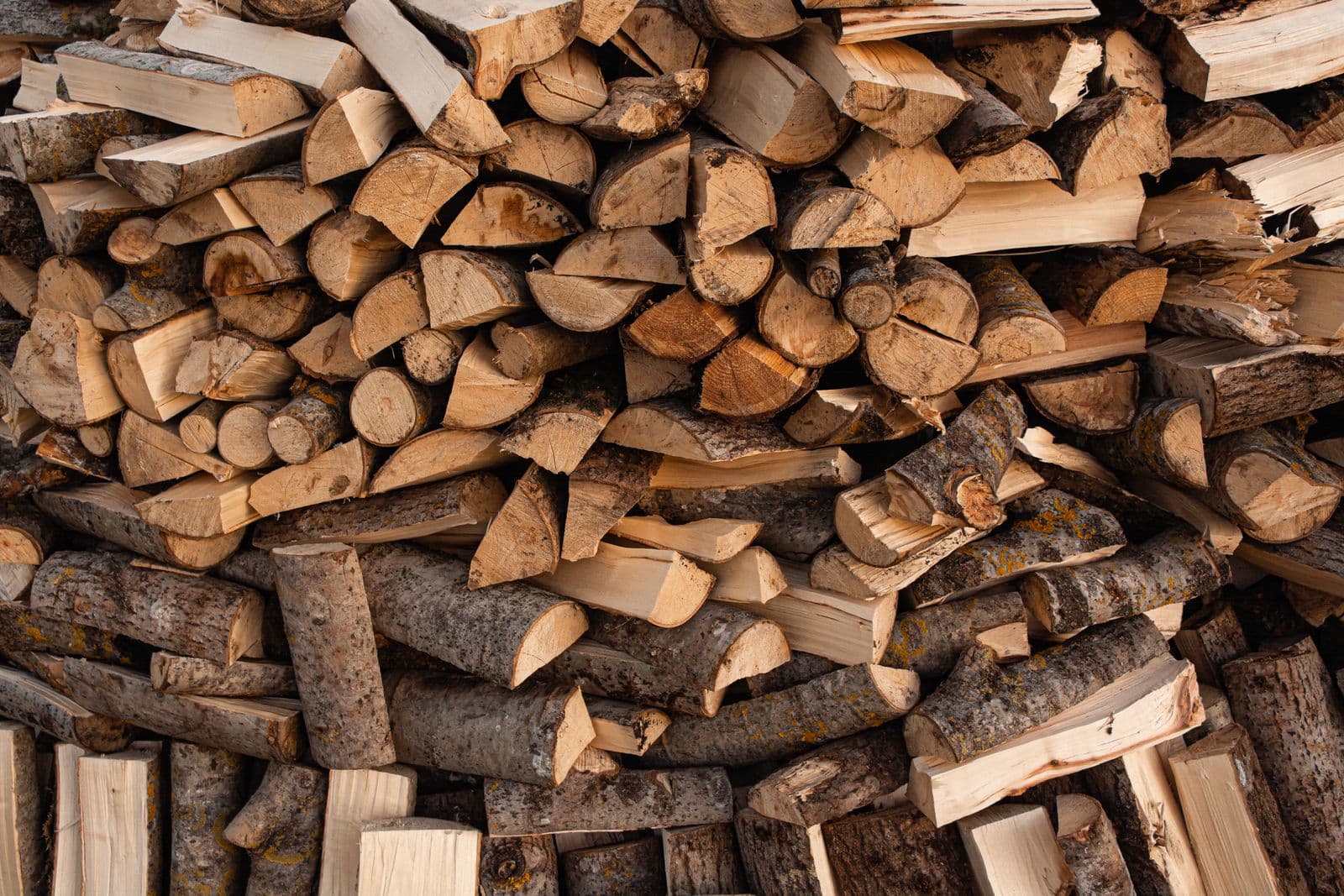

Firewood matters more in Florida, not less
A Florida fireplace might burn a few dozen evenings a year: a stretch of December cold snaps, some January fronts, maybe a chilly February weekend. It is tempting to conclude that with so few fires, the wood barely matters. The opposite is true. When your entire burning season fits into a couple of months, every fire is a larger share of the total, and a habit of burning poor wood does its damage in concentrated doses.
Florida also stacks the deck against good firewood in a way drier states do not. Wood dries by giving up moisture to the air around it, and our air spends most of the year already loaded with moisture. Add near-daily summer downpours, and a woodpile that would season easily in Arizona sits damp and stalled here. Getting truly dry wood in Florida is not automatic. It is the result of choosing the right species, giving it real time, and storing it correctly. This guide walks through all three.
Seasoned oak: the regional staple for a reason
Ask around at any Florida firewood yard and the answer comes back the same: oak. Live oak, laurel oak, and water oak grow everywhere from the Panhandle to the Keys, which makes oak the wood that is actually available, cut locally, and sold by people who handle it year-round. Availability alone would make it the default, but oak also happens to be genuinely excellent fireplace fuel: a dense hardwood that burns long, hot, and steady, leaves a good bed of coals, and carries far less sticky resin than the pines it shares the landscape with.
Density is the property doing the work. A dense log packs more fuel into the same size piece, so it burns longer between reloads and holds a hotter, more stable fire. A hot, stable fire is exactly what a chimney wants: strong draft, complete combustion, less smoke. The trade-off is that dense wood is also slow to give up its water. Oak is famously stubborn to season, and in Florida’s humidity, that stubbornness stretches further than most homeowners expect.
What “seasoned” actually means
A freshly cut log is astonishingly wet. Depending on species and season, water can account for a large fraction of its weight, sometimes approaching half. “Seasoning” is nothing more than letting that water leave: the wood is split and stacked, and over months the moisture migrates out until the log reaches roughly 20 percent moisture content, the widely used benchmark for fireplace-ready wood. Below that line, wood lights easily, burns hot, and sends most of its energy into the room. Above it, a meaningful share of every fire is spent boiling water instead of making heat.
You can check seasoning without instruments. Seasoned wood shows deep cracks radiating from the cut ends, has faded from fresh tan to weathered gray, feels light for its size, and gives a sharp, hollow crack when two pieces are knocked together (green wood lands with a dull thud). Bark loosens or falls away. In the fire itself, wet wood confesses immediately: it hisses, bubbles moisture at the ends, and produces heavy smoke with weak flames.
An inexpensive pin-type moisture meter removes the guesswork entirely, and it is the single best purchase a Florida wood burner can make. The trick is to test correctly: split a piece open and press the pins into the freshly exposed face, not the outside. Florida wood is notorious for reading dry on a surface the sun baked yesterday while the core is still wet. And the core is what your fire actually burns.
Why the clock runs slower in Florida
Wood is hygroscopic: it constantly trades moisture with the surrounding air, drying toward a balance point set by the humidity around it. In an arid climate that balance point is low and the trade runs one direction: out. In Florida, humid air keeps the balance point high year-round, so the woodpile dries in slow motion, and every afternoon storm that wets the stack claws back progress. The practical consequence is simple: timelines quoted for other climates do not apply here. Plan on 12 months or more of proper seasoning, and for dense oak, closer to a year and a half is a safer assumption than a hopeful summer.
Two details move that timeline in your favor. First, the clock starts when the wood is split, not when the tree comes down: a whole round is armored in bark and dries at a crawl, while splitting exposes the wet interior grain to air. Split smaller than feels necessary; in this climate, surface area is your only real ally. Second, buy or cut on next winter’s schedule, not this one’s. The oak you stack this spring is honest fuel for the winter after next, and homeowners who stay one season ahead never face December holding a pile of wet wood.
Storage: covered on top, open on the sides
Florida firewood storage has to solve two problems at once: rain from above and humidity from all sides. The arrangement that solves both is a stack raised off the ground (on a rack, pallets, or blocks) with a roof over the top and the sides left open. The cover sheds our near-daily summer rain; the open sides let breeze move through the stack and carry moisture away. The classic mistake is wrapping the whole pile in a tarp to “protect” it. A sealed tarp in a Florida summer turns the stack into a greenhouse: trapped moisture condenses under the plastic, drying stops, and mold and rot start instead.
Ground contact is the other quiet killer, and in Florida it comes with teeth. Wood stacked directly on soil wicks up ground moisture and never fully dries, and it lays out an invitation to subterranean termites, which thrive across this state and treat a damp woodpile as both food and highway. That is also why the stack belongs a healthy distance from the house rather than leaning against the stucco, so the pile never becomes a bridge for pests. Bring inside only what you will burn within a day or two.
The woods to leave out of the fireplace
Green wood tops the list for reasons the seasoning sections already made clear: it wastes heat boiling water and smokes heavily while doing it. Pine and the other sap-rich softwoods are Florida’s second temptation, since fallen pine is everywhere after a storm. A stick or two of fatwood pine as kindling is a fine old Southern habit: it lights fast and hot. As the main fuel, though, pine burns quick, pops embers, and carries resin that adds to the flue’s workload. Burn it occasionally and small if at all; build your fires on oak.
Driftwood deserves its own warning, because it looks so appealing and behaves so badly. Wood that has soaked in seawater is loaded with salt, and salt in a fire does two ugly things: the chlorine it carries forms corrosive compounds in the flue gases that attack metal components (dampers, liners, caps, chase covers), and the residue it leaves behind keeps working on the flue long after the fire is out. Leave it on the beach.
The rest of the do-not-burn list is about what is on or in the wood rather than the species. Pressure-treated lumber, painted or stained boards, plywood, and particleboard all release chemicals never meant to move through a residential flue. Construction scraps are trash, not fuel. And palm, Florida’s most abundant “tree,” is a grass in disguise: stringy, moisture-laden, and miserable to split and burn. When a storm drops a palm in your yard, haul it to the curb, not the woodpile.
How bad wood becomes creosote
Here is the mechanism that connects everything above to your chimney’s health. Creosote is what condenses on flue walls when smoke cools before it escapes. Every wood fire sends unburned compounds up the chimney; a hot, fast-drafting fire carries most of them out the top, while a cool, smoky fire lets them condense on the flue interior: first as soft soot, then as crusty flakes, eventually as a hardened glaze that is the fuel for chimney fires and the most difficult deposit for any sweep to remove.
Wet wood is the perfect creosote machine. The fire wastes its energy boiling water, so it burns cooler; cooler combustion is less complete, so the smoke is thicker with unburned material; and all that water vapor rides up the flue, cooling the gases further and giving the tar something to condense with. Every stage of the process tilts the wrong way at once. This is why the difference between wood at 20 percent moisture and wood at 35 is not a matter of taste. It is the difference between a flue that stays serviceable and one that layers up hazard with every fire.
Burning habits finish the job in either direction. Fires that are lit hot and kept bright (dry oak, plenty of air) keep flue temperatures up and deposits down. Fires that are choked down to smolder overnight manufacture creosote even from decent wood. Because no fuel or habit is perfect, NFPA 211’s standard applies regardless: annual inspection for any chimney that burns wood, and sweeping whenever the buildup warrants it. Good firewood stretches the interval between cleanings; it does not replace them.
Buying firewood in Florida without getting burned
When you buy, ask two questions and verify one. The questions: what species is it, and when was it split? “Seasoned” on a roadside sign is a claim, not a measurement. Wood split six weeks ago is green wood with a suntan, whatever the sign says. The verification: split a delivered piece and put your moisture meter on the fresh face before the truck leaves. Know the units too. Firewood is properly sold by the cord (a stack measuring 4 by 4 by 8 feet), while a “face cord” or “rick” is a fraction of that; vague terms like “a truckload” make price comparison impossible.
Buy close to home. Moving firewood long distances spreads invasive tree pests, and Florida’s forests have enough enemies already. A local supplier selling local oak is the right answer on every axis. Then apply the one-season-ahead rule from earlier: the best time to buy next winter’s wood is right after this winter ends, when you can give it a full Florida year on a proper rack.
If the fireplace has burned unknown or poorly seasoned wood, or its service history is unclear, arrange an appropriate paid inspection before the burn season. Inspection findings and any proposed repair estimate serve different purposes. A technician can visit the property and give a free estimate, with no deposit required for that visit.