
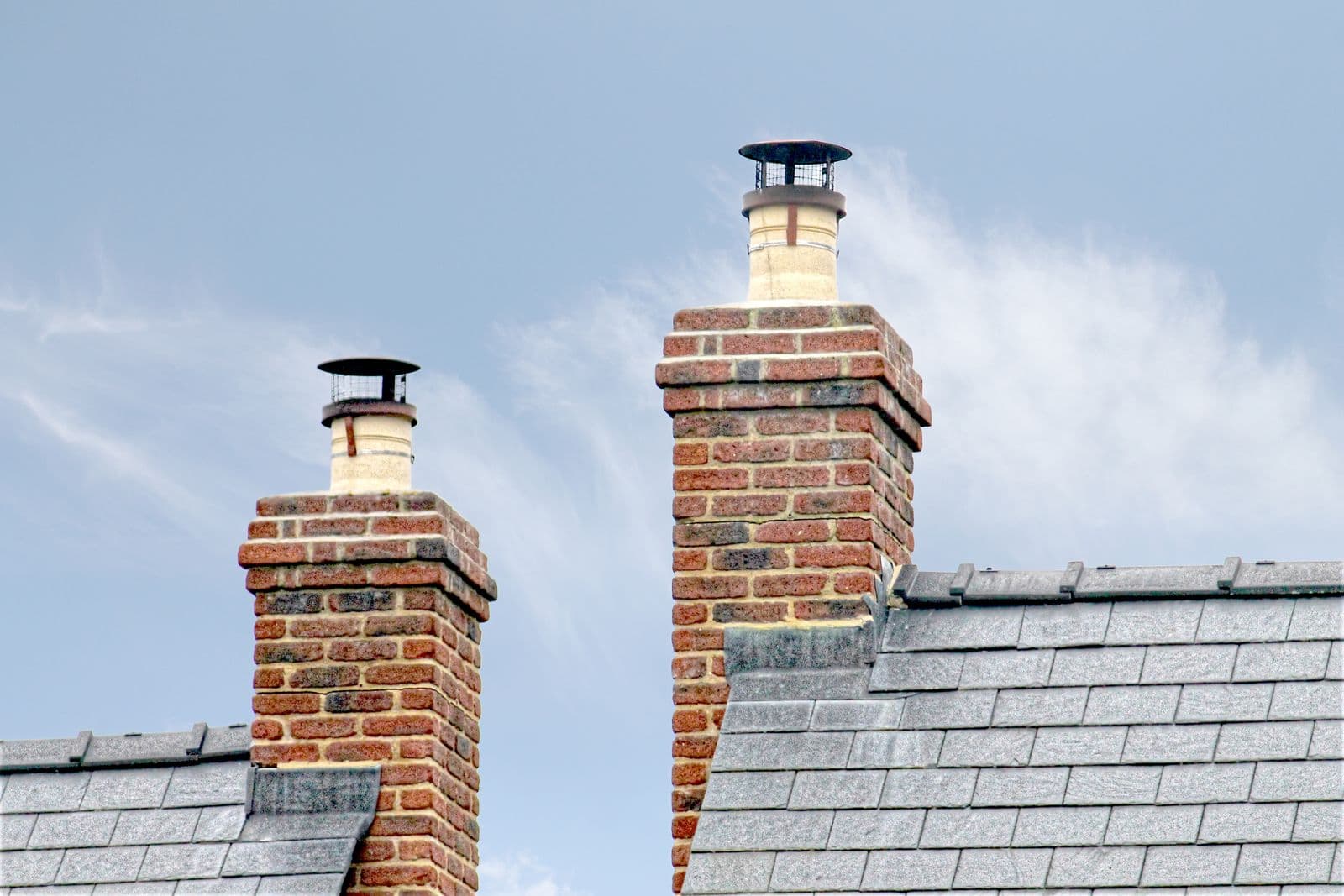

The two chimneys, and why the difference is the first question
Every fireplace in Florida is one of two fundamentally different things, even when they look identical from the couch. A masonry chimney is built on site from brick or block, lined with clay tile or a metal liner, and topped with a mortar crown: a heavy, permanent piece of the house's structure. A factory-built chimney (the trade calls it "prefab") is a manufactured appliance: a metal firebox and a metal chimney pipe, assembled in a factory, dropped into a framed wood chase, and finished to match the home. One is masonry; the other is machinery wearing a masonry costume.
Knowing which you own is not trivia. The two are governed differently, fail differently, last different lengths of time, and (most important when you are about to spend money) are repaired in completely different ways. A part that fixes one can be dangerous on the other. A price that is fair for one is wrong for the other. Nearly every bad chimney decision we see in Florida starts with a homeowner, or a handyman, guessing the type wrong, so this is the first thing to settle before any work is booked.
The good news is that you can usually tell them apart yourself in a few minutes with a flashlight. This guide walks through every tell (inside the firebox, up the flue, and outside at the roofline) so you know exactly what you have before the first pro ever sets a ladder against the house.
The fastest tell: look inside the firebox
Open the doors or screen, grab a flashlight, and look closely at the walls and floor of the firebox. This alone answers the question most of the time. A masonry firebox is built from individual firebricks, and you will see real mortar joints between them: separate tan or buff bricks, often laid in a herringbone or stacked pattern on the back wall, with visible grout lines you can catch a fingernail in. It is one solid, heavy, monolithic mass, with no seams or gaps anywhere.
A factory-built firebox looks similar at a glance but gives itself away up close. Its walls are refractory panels: large cast pieces molded to imitate stacked brick, with the "mortar lines" pressed into a single smooth panel rather than laid by hand. Look at the corners and edges: instead of mortar you will find metal seams, thin gaps, or a metal frame where panels meet the steel body. Around the opening there is usually a metal surround, and often louvered vents that circulate room air, something a solid masonry firebox never has.
One more corner check settles borderline cases. In a masonry firebox the back and side walls meet in mortar; in a prefab they meet at a visible metal joint, and you can often glimpse the steel shell behind the panels through those gaps. Cast refractory panels tend to be a uniform gray and perfectly regular, while real firebrick varies from brick to brick. If you see steel and molded panels, you have a factory-built unit, full stop.
Look up the flue, then look at the roofline
The flue confirms it. Shine your light straight up with the damper open and note what lines the passage above the firebox. A masonry chimney is lined with clay flue tile. You will see a squared or round orange-red terracotta channel, sometimes brick. A factory-built chimney vents through a round metal pipe, so you will see shiny or dull metal, usually stainless, in neat cylindrical sections. Clay tile means masonry; a round metal pipe means prefab, every time.
Outside, the two look most different at and above the roofline. A masonry chimney is a solid brick or block stack running unbroken to the top, capped by a mortar or concrete crown that sheds water, usually with a clay flue tile poking up through it. A prefab lives inside a chase (a framed box clad in siding, hardboard, or stucco) and is topped not by a masonry crown but by a chase cover: a flat metal pan with the round flue pipe and its cap protruding through the middle.
Florida adds a trap worth naming. Plenty of prefab chases are finished in stucco or thin brick veneer to match CBS, concrete-block-and-stucco homes, so a stucco "chimney" can still be a factory-built unit inside. When the exterior is ambiguous, the top settles it: a real masonry crown is a sloped mortar wash with tile through it, while a chase cover is unmistakably a metal lid. And when in doubt, the firebox never lies. Trust what you saw inside over what the outside is dressed up to look like.
The listing plate is the tiebreaker
There is one detail that ends every argument: the listing plate. Every factory-built fireplace and chimney carries a stamped metal label, often a UL listing plate, fixed inside the firebox on a side wall, on the surround, or just inside the opening. It names the manufacturer, the model number, and the required clearances to combustible framing. A masonry fireplace has no such plate, because it was built on site rather than manufactured. If you find a metal rating label, you own a prefab; if there is genuinely none anywhere in or around the firebox, you almost certainly own masonry.
That plate is not just an ID tag. It is the rulebook for any future repair. Under NFPA 211, the standard that governs chimneys and fireplaces, a factory-built system must be repaired only with the listed components made for that specific model, and it must keep the clearances the label specifies. That is why a good pro photographs the plate before quoting anything: the make and model determine which parts even exist, whether they are still available, and whether the unit can be repaired at all or has to be replaced.
One is a structure, the other is an appliance
The deepest difference is almost philosophical, and it drives everything about cost and longevity. A masonry chimney is a structure. Maintained (crown intact, cap on, flashing sound, joints repointed as they age) it can serve for generations, and when a part wears out you repair that part: repoint the mortar, rebuild the crown, replace a cracked flue tile, reline it, or rebuild the top few courses. You very rarely "total" a masonry chimney; you keep restoring it piece by piece over its long life.
A factory-built unit is an appliance with a service life, closer in spirit to a water heater than to a brick wall. Its lifespan is generally measured in a couple of decades rather than generations, and it is engineered to be replaced rather than rebuilt. You cannot repoint a metal firebox or patch a cracked refractory panel with mortar; you install the manufacturer's listed replacement part, and if that part is discontinued, the correct and safe answer is often a new unit. Neither approach is "better"; they are simply different machines with different rules.
This is why the same symptom leads to very different conversations. A cracked masonry crown is a routine repair on a chimney that will outlive the mortgage. A warped or burned-through prefab firebox can condemn the whole appliance if parts are gone. Understanding which world you are in tells you whether you are looking at ongoing upkeep or an eventual replacement, and keeps you from overpaying to "restore" something that was built to be swapped out.
How each type fails in Florida
Florida is unusually hard on both, in its own way for each. On factory-built systems the metal is the weak point, and salt air is the enemy. The chase cover, that flat metal pan on top, is the first casualty near the coast: it collects standing water and salt, rusts through, and then rain pours straight into the chase where no one can see it until a ceiling stains. The round metal chimney and its cap corrode next, and cracked refractory panels or a warped firebox follow from years of use or a single overfire.
Masonry chimneys fail through water and time. Florida's constant humidity and heavy, wind-driven rain work into the mortar joints and erode them; once water is in the brick, our salt air and the Panhandle's occasional winter freezes flake the faces off in a process called spalling. The crown cracks, flue tiles deteriorate, flashing at the roofline lets water in, and white efflorescence stains bloom where moisture is passing through. Left alone, a saturated masonry stack can lean or shed brick, but every one of these is a repairable stage, caught in time.
The common thread is water, and the coast multiplies it. Salt accelerates metal corrosion on prefab systems and chemical breakdown on masonry alike, which is why a chimney a few blocks from the Atlantic or the Gulf ages faster than the same chimney inland. Whichever type you own, keeping water out (a sound cover or crown, an intact cap, good flashing) is the single highest-value thing you can do in this climate.
Repair paths, and what actually drives the price
Because the two are different machines, the repair menu is different, and so is the price logic. On a masonry chimney the work is incremental and the chimney is rarely beyond saving: repointing eroded joints, rebuilding a cracked crown, waterproofing with a breathable sealer, resealing flashing, relining with a stainless liner, or rebuilding the courses above the roofline. What separates those jobs on price is how much of the stack has to come apart: repointing a run of joints or fitting a cap is a single part or a single surface, a crown rebuild means demolishing the top and casting a new one, and an above-roof rebuild takes the stack down course by course and puts it back, with height and access driving the labor on every one of them.
On a factory-built unit the work is parts-driven, so the price follows the part. A rusted chase cover is remade in stainless, priced by its size and the gauge of metal it is cut from; the listed cap is replaced with the correct model; and cracked panels are swapped for the manufacturer's parts. The pivotal question is availability: if the model is discontinued and no listed parts exist, the safe path is a full unit replacement, and that is the one outcome on the prefab side where you are buying an appliance instead of a component. Roof pitch, height, coastal exposure, and access move every one of these, which is why an on-site estimate is the only honest price.
The trap to avoid is mixing the two worlds. Sealing a prefab flue with mortar, fitting a generic masonry cap on a metal chimney, or "restoring" a factory-built firebox with refractory cement instead of listed panels are the kind of shortcuts that fail inspections and create fire risk. Matching the fix to the type is not fussiness; it is the difference between a repair that lasts and one that quietly becomes dangerous.
Get the type right before you book, and what a pro checks
Settling the type first protects both your safety and your wallet. It tells you whether you are buying a part or a whole appliance, whether a quoted price is even in the right ballpark, and whether a proposed fix is legitimate for what you own. If a contractor quotes a masonry rebuild without ever finding your listing plate, or proposes patching a metal firebox with mortar, that alone tells you they have not identified the chimney correctly, and you should pause before signing anything.
Identification may involve the firebox, accessible flue, exterior, roofline components, and the data plate on a factory-built unit. Access, weather, and available product information affect what can be confirmed during a visit. Any proposed repair, component, material, price, and applicable job terms should appear in the job-specific proposed work rather than be promised in advance.
Chimney Repair Service is family-owned and proudly American-owned. If you are not sure what type of system you have or have spotted rust or crumbling masonry, request a free estimate visit so a technician can look at the requested concern at the property.